ˋ༺✧༻ˊ
~Fintaria~
ˋ༺✾༻ˊ
༺Cerriens༻
~Physical Appearance~
Cerriens are feline-based creatures, with two large eyes set vertically on the face, and ear tufts. Most cerriens' tails are thin, with an pointed tip. Although, some, such as Feather, have tufted tips instead. Cerriens in Glaciterria have thicker fur on their tails to keep themselves warm in the cold climates. Moorestians grow thicker fur only in the winter months and then shed their winter coats in spring.
Some cerriens have horns on top of their heads and/or spikes along their backs that glow in the dark alongside their eyes. Any horns or spikes' glowing features can be activated on and off, though (alongside the eyes) are dimmed when the cerrien is especially tired or weak. Scorpoterrians are the only tribe with the ability to willingly dim the glow in their eyes, an advantage when hunting in the darkness of dawn, dusk, and/or nighttime. The only time the eyes would completely stop glowing in the dark is if the cerrien is dead. Or so is believed...
They each have three toes on each paw, with a fourth almost opposable "thumb." Each paw has four retractable claws, and some cerriens are even born with webbed feet.
Cerriens of all tribes can have a variety of patterns, such as spotted, striped, brindled, solid, or pointed. Some rarer patterns are more common in certain tribes than others. For example, a cerrien with rosettes (large spots similar to what leopards have) is most commonly found in Glaciterria - with a pattern and color combination most comparable to a snow leopard.
Some cerriens can be born with special physical abilities. For example, the cerrien Inferno and his father Volcano each can generate their own body heat in the parts of the body containing orange fur. This can be helpful during winter. They also grow brighter during times of extreme excitement, anger or fear, and grow dim during times of sadness.
~Measurements~
Weight: 10-25 lbs. (4.5-11.3 kg.)
Height (at the shoulder): 10 in. (0.2 m.)
Length: about 18in. (0.4 m.) long (The tail can vary greatly in its length.)
Speed: Around 35 miles per hour Life Span: 25-30 years
Date of hatching-1 year: a kitten
1-3 years: juvenile
3-6 years: Young adult
6-29 years: adult
29-35 years: senior
~Senses~
Eyesight: They see all colors that humans see, with exceptionally good vision. In the dark they have night vision.
Hearing: Very good hearing, with desert cerriens able to hear mice tunneling underground Smell: Can identify scents of individual cerriens and their tribes Taste: They, unlike a regular domestic cat, can taste sweets
~Body Language~
Tail up - happy
Tail up and head bowed - respectful greeting to a cerrien of higher authority
Lashing tail - angry, frustrated, irritated
Tail-tip twitching - anxious or excited
Tail curled over back - amused Twitching tail-tip - impatient
Tail held down - relaxed Tail curled around paws when sitting - relaxed
Tail curled around another cerrien - affection, protectiveness
Fur bristling - angry, frightened
Touching noses with another cerrien - casual friendly greeting
Rubbing muzzle against another cerrien's cheek - affection
Lick on the cheek or back - closer affection
Lick on the ear - general friendliness, comfort
────ˋ༺✧༻ˊ────
༺The Subspecies/Tribes of Fintaria༻
~Moorest~
Habitat: temperate forest/moorland
Physical traits: average size, medium length fur, medium-sized ears
Fur colors: any - seen as the most diverse of the subspecies
Diet: small mammals, birds, sometimes fish
Temperament: usually friendly
Fun facts: The first subspecies to exist, the closest relatives to the first cerriens (called the First Ones). They are the tribe that every cerrien stems from.
~Scorpoterria~
Habitat: Desert
Physical traits: a little taller, shorter fur, Large ears, small tufts of fur on their feet, have the unique ability to dim the glow in their eyes for night hunting
Fur colors: tans, orange, brown, cream
Diet: lizards, birds, snake eggs, small mammals, and insects
Temperament: Typically hostile, especially to Moorest
Fun facts: Very skilled at fighting, their tribe is split into Moonlight and Sunlight cerriens depending on their ability to withstand heat and cold (See more in "General Way of Life")
~Thermoterria~
Habitat: A special forest filled with "Everthermo" trees. These colorful trees can generate heat from their trunks, providing the forest with more warmth than Moorest.
Physical traits: long legs and tail for climbing, Shorter to medium-length fur, medium sized ears,
Fur colors: brown, gray, or black
Diet: Small mammals (mostly squirrels), birds
Temperment: Friendly
Other facts: Their dens are in the trees, built with sticks and mud and connected by the tree branches
~Glaciterria~
Habitat: mountains and a valley of mountain grasslands with scattered areas of pine trees
Physical traits: long fur, tufts of longer fur on paws, longer tail, and small ears
Fur colors: white and shades of gray
Diet: mice, snow hares, birds
Temperament: shy, very secretive, mysterious
Other facts: live on the side of a mountain in many caves, some connected by tunnels
~Maliterria ***NOT OFFICIALLY RECOGNIZED AS A TRIBE***~
Habitat: pine forest, rocky areas
Physical traits: any, a mix of the other four groups
Fur colors: any, a mix of the other four groups
Diet: anything they can find
Temperment: usually VERY hostile
Other Facts: full of outcasts that have no government system or laws
~Soliterria~
Soliterria itself is not a tribe, but an expanse of territory containing deciduous, pine, and everthermo forests as well as mountains. It is said to be a neutral ground where no cerriems have settled or laid claim to it to refrain from the possible threat of war, but some say its history is a little more haunted...
~Alliance Forest~
Alliance Forest is a forest in-between Moorest and Thermoterria, consisting of both regular deciduous trees and everthermo trees. It is a shared territory that the two tribes each use to gather medicine or food in times of hardship or when supply is low in either tribe's territory. It is also used as a symbol to represent the unity between the two tribes.
ˋ༺✧༻ˊ
༺Borders and Maps༻
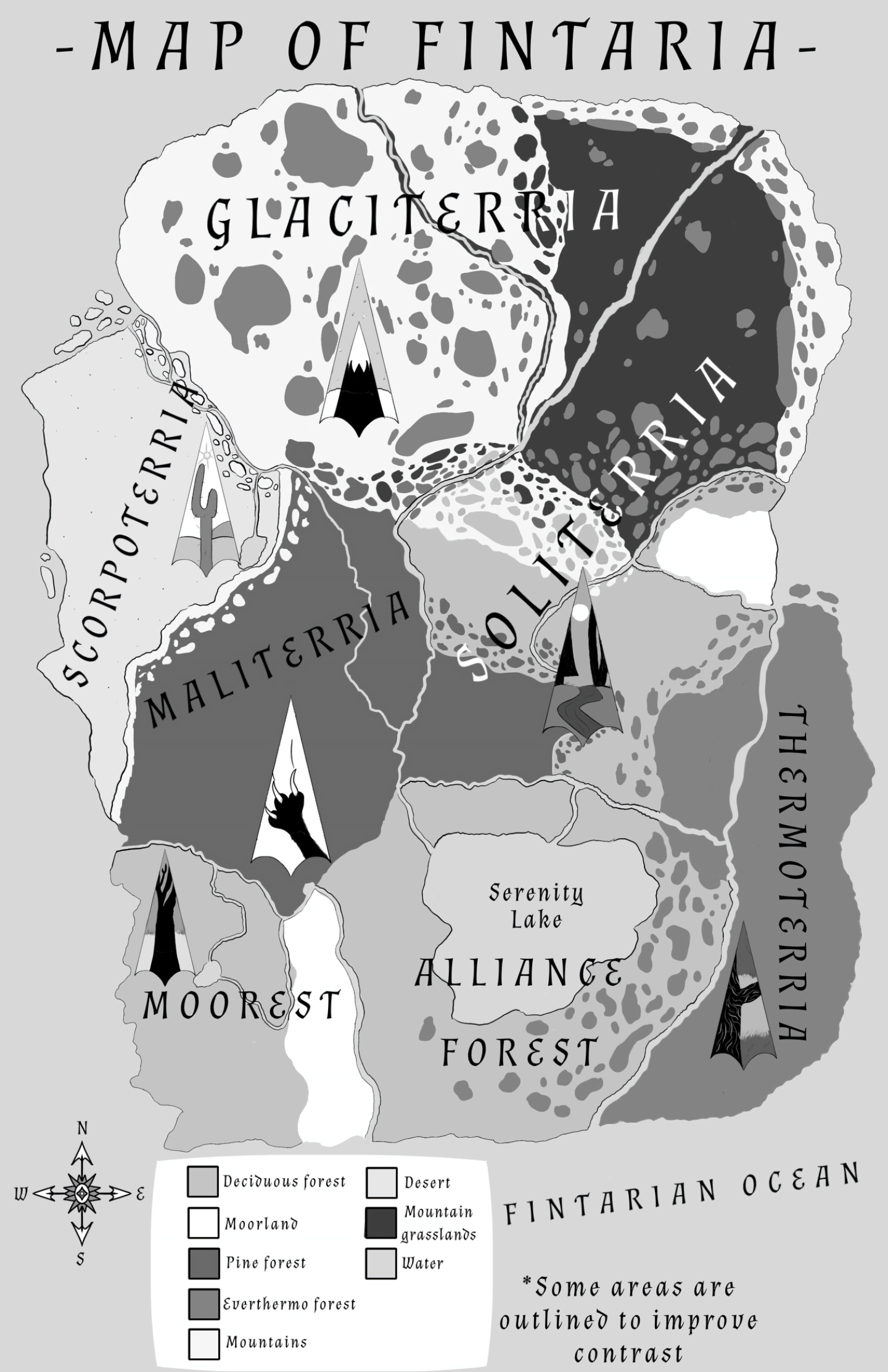
Most, but not all territories use the various rivers and streams cutting across the continent to mark their borders.
~Moorest's Borders~
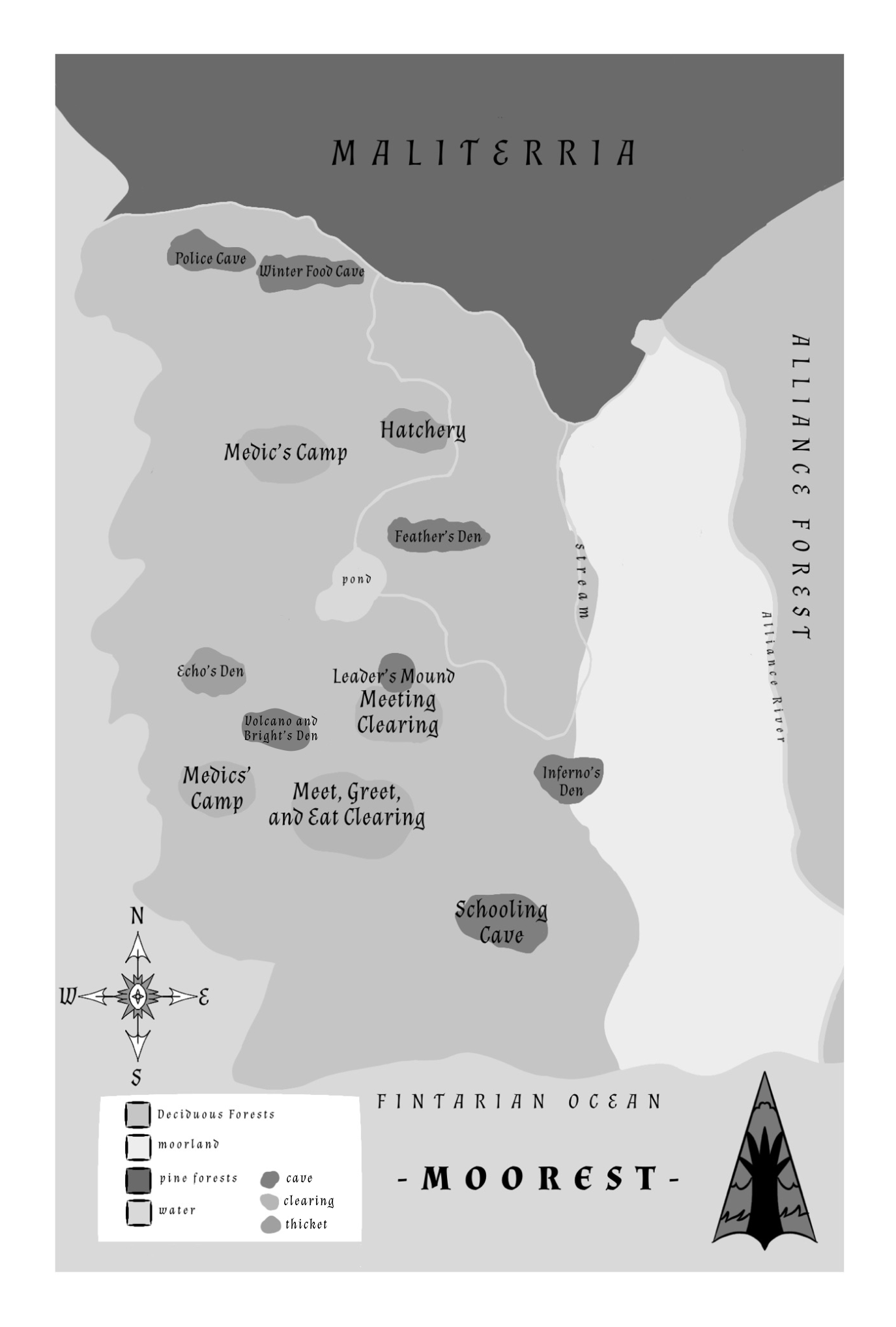
Maliterria: the northern border, a river that separates the deciduous forest from the Maliterrian pine forest Alliance Forest: the eastern border, a stream where the moorland ends
~Alliance Forest's Borders~
Moorest: the western border, a stream that divides the area of deciduous forest from the moorland
Maliterria: the northwestern border, a river that runs from eastern Fintaria and splits to the north and south about halfway across, with the rest of the border being the sudden divide between deciduous and pine trees
Soliterria: the northeastern border, the same river that marks part of the Maliterrian border
Thermoterria: the eaastern border, a river that runs from the fork in the long Thermoterrian river all the way south until the Fintarian Ocean and the southmost point of Thermoterria
~Maliterria's Borders~
Moorest: the southwestern border, a stream that runs from the east to a small pond in the southeast and is the firm boundary between deciduous and pine forests in the region
Alliance Forest: the southeastern border, the abrupt transition from pine trees to deciduous trees until the river running alomg Soliterria's border
Soliterria: the eastern border, a river that contains from Glaciterria south until its second split at the top of Alliance Forest
Glaciterria: a northern border, a short spanse of land between two rivers that transitions from pine forest to mountains
Scorpoterria: the northwestern border, a thin line of rocky mountains that extends from Glaciterria all the way down to the near-bottom of Maliterria
~Soliterria's Borders~
Maliterria: the western border, a river that runs from Glaciterria to Serenity Lake
Alliance Forest: the southern border, a river that begins at the second split of the current that snakes down Maliterria, then travels east until flowing into the river that borders Thermoterria
Thermoterria: the eastern border, a river that runs from the Fintarian Ocean through the northwestern part of the everthermo forest to its split across the border with Alliance Forest
Glaciterria: the northern border, a river flowing from the northern Fintarian Ocean until veering off to run along Maliterria
~Thermoterria's Borders~
Soliterria: the northwestern border, a river that comes from the nothernmost point of Thermoterria down until the fork near the middle
Alliance Forest: the southwestern border, the continuation of the Soliterrian border river past the fork, flowing south until the southern Fintarian Ocean
~Glaciterria's Borders~
Soliterria: the southeastern border, the river starting from the northern Fintarian Ocean and flowing along scattered patches of tundra and pine forest until veering pff to run along the edge of Maliterria
Maliterria: the southwestern border, a brief stretch between two rivers, transitioning from mountains to pine forest
Scorpoterria: the western border, a river starting from the northwestern Fintarian Ocean and heading first into mountains, then weaving its way through areas of desert and then back along the mountains until splitting into a fork in southeastern Scorpoterria
~Scorpoterria's Borders~
Glaciterria: the eastern border, a river further east of two rivers that meetnear the northeast and weaves through barren, rocky landscape that includes scattered elevated ground until flowing down south into Maliterria
Maliterria: the southern border, a thin line of rocky mountains that begins at Glaciterria and runs west and then southwest until stopping at the coast
~Fintaria's Map~
~Moorest's Map~
~The Spirit World~
The Spirit World is where all cerriens go when they die. It exists as an ever-expanding parallel universe to Fintaria - the Living World. It has the same geography and landmarks, but on a much larger scale. Cerriens that died of old age are young again, and cerriens who died very young are still able to grow up, but stop aging once they've reached adulthood (3 years). Eggs that died before hatching are taken to a hatchery in the Spirit World and usually adopted by another ghost.
Adult ghosts are given magic upon entering the Spirit World. This magic is used to generate tools to aid a cerrien, such as ways to tell time or communicate quickly with others. Kittens in the Spirit World don't receive magic until they are 3 years old. However, using this magic requires energy and can tire a ghost out if they use it excessively.
The Spirit World is basically a larger clone of Fintaria in a parallel universe. Scorpoterria and Glaciterria have cemeteries, but Moorest and Thermoterria don't and bury their dead in any place in the territory that might be significant (such as a favorite spot of the dead cerrien). A copy of each grave in the Spirit World hosts a portal connecting to the Living World version of the grave, so that the spirit can go to and from the Living World. A portal is created when a dead cerrien is buried and/or given a funeral.
While the ghosts can visit the Living World in death, they are invisible to all the living inhabitants of Fintaria (unless a Spirit-Watcher is present). Like using magic, going to and from the Spirit World takes energy, and a ghost has a maximum time of 24 hours in the Living World before they have to return to the Spirit World to rest and regain their energy.
Every century, a single cerrien (could be from any tribe, including Maliterria) is born with the ability to see and communicate with the ghosts - known as the Spirit-Watcher. This cerrien is sacred by all, and treated with the highest of respect. A Spirit-Watcher is recognizable by a cerrien wearing a light pink cone hat, with the letters s and w written down the front. The very first Spirit-Watcher was Fin, whom the continent of Fintaria was named after.
ˋ༺✧༻ˊ
ˋ༺Government and Roles in the Tribes༻ˊ
~Moorest~
Three Leaders: all make decisions together, elected by the public
The Court of Advisors: six cerriens that advise and help the leaders make decisions, elected by the leaders no
If the leaders can't come to a final decision, they usually either consult the advisors or hold a vote for the public to decide.
If a leader dies, they are replaced by a member of the Court of Advisors (voted by the public)
Other roles in the tribe include Lawkeepers (police), medics, defenders (consisting of sentries and scouts), teachers, and hatchery workers
~Scorpoterria~
Monarchy: King/Queen/Monarch
The oldest child of the monarch will take over the throne after they die. If they have no children, they will choose a successor among their own Court of Advisors
Court of Advisors: six cerriens chosen by the monarch to aid in decision-making
Other roles in the tribe include medics, the Royal Guard (act as both Lawkeepers and sentries/scouts), teachers, hatchery workers, and royal servants (at the bottom of the hierarchy). Scorpoterrians divide their roles into moonlight and sunlight: those with slightly thicker fur do their duties at night, and those with thinner fur do their duties during the day.
~Thermoterria~
Three leaders: all make decisions together, elected by the public
The Council of Advisors: six cerriens that advise and help the leaders make decisions, elected by the leaders
If the leaders can't come to a final decision, they usually either consult the advisors or hold a vote for the public to decide.
If a leader dies, they are replaced by a member of the Court of Advisors (voted by the public)
Other roles in Thermoterria include medics, ground scouts, tree scouts, hatchery workers, and teachers.
~Glaciterria~
Two Leaders: usually partners or close friends that are elected by the public
Two Deputies: next in line to become leader, advise the leaders in decision-making
Every five years, a vote is held to determine if one or both leaders should step down and be replaced by one of the deputies. The leaders and deputies are expected to closely bond with each other during their work in the event of one leader stepping down and leaving one of the deputies to become the new leader, since the two have to work together. If a deputy steps up as leader, an election is held to decide the new deputy
If the leaders can't agree on a decision, they consult the deputies or have the public vote.
Other roles in the tribe include medics, cave sentries, mountain scouts, grassland scouts, hatchery workers, and teachers.
ˋ༺✧༻ˊ
ˋ༺General Way of Life༻ˊ
In almost all groups, cerriens have their own private dens and will live alone or with a family member.
While the rest of the tribes are diurnal, Scorpoterria is mainly crepuscular/nocturnal. They don't sleep in long stretches like the other tribes do. Instead, they sleep in bursts throughout either day or night. If a cerrien has slightly thicker fur, they are deemed a Moonlight cerrien. They carry out the majority of their duties at night and sleep the most during the day. Scorpoterrians with thinner fur do the opposite: perform their activities during the day and sleep the most at night. However—because the physical differences between these two subcategories aren't very extreme—these guidelines are not rigid, and it is common practice for a Sunlight cerrien to be awake at times during nighttime, and vice versa. Dawn and dusk are when the most Scorpoterrians will be awake, and therefore when the Sunlight and Moonlight cerriens get together and discuss important tribe matters or simply catch up with friends.
While it is not common in other groups for cerriens to live alone, it is standard in Scorpoterria for two or three Sunlight cerriens (siblings, friends, or partners) to live in a den together and share a nest (a sandy dip in the ground) to keep each other warm during the chilling cold of the desert at night.
~Partners~
A partner for a cerrien is a little different than what humans percieve it as. In Fintaria, a partner is a title referring to a companion that the cerrien shares a very deep, emotional bond with - one chosen cerrien that has a unique bond with another. There are two types of cerrien partnerships: pink and yellow.
Similarly, the word "crush" refers to anyone a cerrien has the desire to be partners with. Partners are separated into the same two categories: pink-crush and yellow-crush.
Pink attraction: closest to the human definition of traditional romantic partnerships, with attraction to a cerrien's appearance, a fondness/admiration for the other cerrien, and a deeply intimate, emotional bond.
Cerriens with a pink-crush often experience physical effects, such as feeling nervous around them, as well as getting jealous or feeling the need to prove themselves to their crush. Its symbol is the pink flower ❀, as it represents romance.
Yellow attraction: intense feelings of platonic love that go beyond a casual desire to be friends with a cerrien. These kinds of relationships often develop from strong, pre-existing friendships, and emphasize emotional intimacy, lifelong companionship, and trust. Many yellow-partners, if they desire, live together and even share a nest. Unlike pink-attraction, yellow-attraction does not by itself include any attraction to a cerrien's appearance. A yellow-partner is a best friend, but not all best friends consider themselves yellow-partners. Yellow attraction's symbol is the yellow flower ❀, meaning strong friendship and companionship.
Sometimes crushes can include both colors. For example, a cerrien may want a yellow-partnership with another while still holding a small amount of romantic attraction to them, and would value them as a friend first and foremost despite still feeling pink-attraction for them. A cerrien is capable of having both a yellow and pink-partner at the same time, but this can lead to conflict depending on the specific nature of both partnerships.
A cerrien asks another to be a partner by giving them the flower of the appropriate color (pink or yellow). If the cerrien accepts, they take the flower. The partnership is considered official when the asked cerrien presents a flower back, representing mutual affection.
Some tribes have more specific customs for asking. In Glaciterria, cerriens only ask in the spring, as that is the time for new beginnings. Scorpoterrians usually ask and receive back in an oasis. This is due to the bigger presence of life in the middle of the dry desert. It signifies that the relationship will survive even in the darkest moments. An oasis is also considered a location of good luck for the future.
If two cerriens become partners, sometimes one or both make matching bracelets. These bracelets are made of colorful stones that stick together and are known for being particularly difficult to get apart, symbolizing the bond between partners. The color choice of these bracelets is completely up to the partners. It is typical that the bracelets are given by one cerrien as a gift, but sometimes the cerriens will make bracelets for each other. This custom is most common in Scorpoterria and Glaciterria, as up north is the most common place to find these stones.
When both partners die, a ceremony is held and the two cerriens become ever-partners, a ceremony representative of the fact that they can now be together for all eternity. The ceremony is a celebration for both the lives of the two cerriens and their relationship.
♡♡♡
~Kittens~
Only pink-partnerships involve having kittens. A cerrien egg is laid at the Hatchery (or in Glaciterria's case, the Hatching-Cave) where one parent stays with it until it hatches. The newly-hatched cerrien will then move to their parent's den.
Once a kitten has reached two months of age, they are old enough to start attending classes of history and cerrien culture. They also learn basic math and how to read and write. In Scorpoterria, this is where their battle training begins.
At six months, their education extends to hunting and fighting, and perhaps another skill they are interested in such as medicine (although medic trainees aren't considered full medics until they have four years of experience). They also learn tribe-specific skills such as climbing rocks in Glaciterria or hunting in trees in Thermoterria. Glaciterrian parents assign a specific teacher to train their kitten, as Glaciterrians believe that the personal bond between teacher and student is incredibly important in a young cerrien's education and life. As a result, many Glaciterrians pay close attention to a kitten's growth if they wish to become that kitten's teacher.
At one year, the young cerrien will move out of their parents' den, and start sharing a den with their siblings. This is when most cerriens stop attending school. However, Glaciterrian cerriens still receive teachings and advice from the teacher they were assigned. If the cerrien is an only-child, they may choose to move in with a friend. At two years, they are fit to find their own dens.
~Hunting~
Cerriens usually hunt alone, but also hunt with friends, siblings, or anyone they are relatively close to. However, Glaciterrians are not permitted to hunt solo due to the possible dangers of slipping off tall cliffs or getting attacked by flying predators such as birds of prey or even dragons or griffins.
Moorestians: ambush prey on the ground or in trees, leap up to catch birds, fish, chase rabbits on the moor ᘛ⁐̤ᕐᐷ
Scorpoterrians: Hide behind rocks to ambush mice and birds, work in groups to scare prey from burrows into another cerrien's paws, lift up rocks to find insects, steal snake eggs 𓆌
Thermoterrians: Often hunt in trees, ambush mice on the ground, can chase squirrels from branch to branch, leap to catch birds 𓅪
Glaciterrians: hide in snow or behind rocks to ambush small mammals, chase hares, leap to catch birds, work in groups to catch larger prey like hawks. 𓅪
~Seasons and Holidays~
Cerriens in Moorest and Thermoterria recognize the four seasons, however there isn't an official day each season starts. Instead, each season starts according to patterns in the weather and climate: winter starts during the first snowfall; spring starts once the snow melts completely; summer starts once the temperatures rise higher; and autumn starts once the leaves have completely changed color and the temperature starts to get cooler. But for them, the year starts in the spring, the season of new beginnings.
The start of each season is a celebration for Moorest, although spring is definitely the largest. Winter and autumn especially signify resilience and the endurance of the tribe to keep going.
Scorpoterria has two seasons - the dry season and the wet season. The dry season starts the new year. The first rainfall of the wet season is a celebration for the kingdom, and activities such as parties, gift-giving, and feasts take place.
Glaciterria celebrates the warm season, when the temperature rises and the heavy snow melts. This is also the start of the new year for them.
~Powers~
Spirit-Watcher: a cerrien born every century with the ability to see and communicate with the spirits that come from the Living World.
Time-Traveler: any cerrien capable of going into or seeing the past or future, which can be done in a few ways:
Spirit Transport: the act of a cerrien's spirit being sent to the past or future, while the living body remains in the present, using this power requires a lot of energy and usually tires a cerrien out after they've finished using it
Dream Foresight: having dreams of what will happen in the future, could be dreams of the near or distant future
Sensing Future Emotions: being able to "sense" or "feel" what will happen in the future (Ex: feelimg a sense of dread before a foreboding event takes place), could be in the near or distant future.
Mind-Wanderer: a cerrien capable of entering into another cerrien's mind and communicatimg with that host through thoughts, able to read that cerrien's mind
ˋ༺✧༻ˊ
~The Meeting Clearing~
Leave a comment or chat with others below!